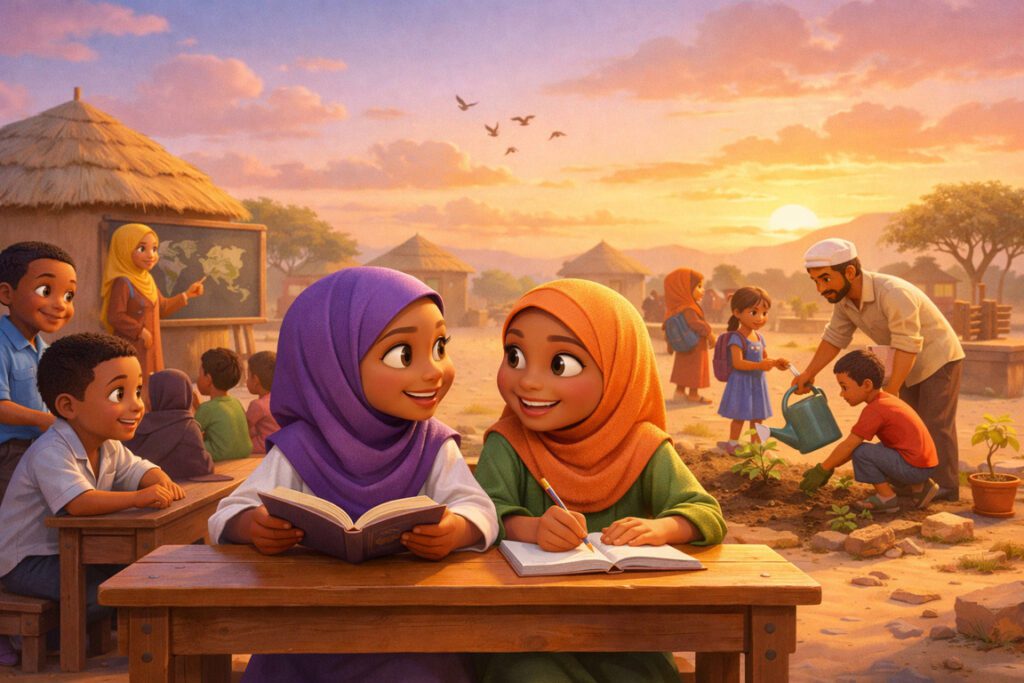
A young girl balancing schoolbooks in one hand and household chores in the other might not look like a revolutionary, but every lesson she absorbs is a quiet act of rebellion against cycles that have spun for generations. The spark ignited by educating a single girl radiates outward, disrupting poverty, unlocking innovation, and healing communities fractured by inequality. The world’s greatest untapped resource does not lie buried underground or locked away in vaults; it walks dusty village roads and city sidewalks, waiting for its chance to rewrite the future. When a community chooses to invest in girls’ education, it unlocks far more than literacy—it unleashes exponential benefits that echo across decades.
Across the globe, data from UNESCO and the World Bank underscores this impact: countries that prioritize educating girls see dramatic drops in child mortality, surges in economic growth, and measurable progress in public health. Somalia, where cultural traditions sometimes shadow progress, is now part of a global awakening. Champions like Al-Amin Somalian Foundation (ASFAFRICA) are proving that sustainable development starts by opening classroom doors to every girl. The story of why educating girls changes everything isn’t just about fairness—it’s the strategy with the highest return on investment for any society.
Strikingly, when girls stay in school, communities reap social dividends that cannot be matched by infrastructure projects or foreign aid alone. A single extra year of schooling can increase a woman’s earnings by up to 20 percent, as highlighted by the World Bank. This boost isn’t theoretical—it’s tangible, changing daily life for families who can now afford better nutrition, health care, and housing. For communities fighting persistent poverty, girls’ education operates like a secret engine, generating progress from the inside out.
From Kismayo Calenley to cities across Africa and Asia, stories abound of women who broke the mold through education. Their journeys become templates for thousands more. As global development experts repeatedly note, when you educate a girl, you educate an entire village. The evidence is overwhelming, the promise undeniable. But what does this transformation look like in practice? That’s where the real story unfolds.
Educated Girls, Healthier Families: The Ripple Effect That Saves Lives
Literacy lessons in a Somali classroom may seem like a small step, but the ripple effect can mean the difference between life and death for families. Women who finish primary and secondary school are statistically far more likely to access maternal health care, seek timely vaccinations for their children, and adopt modern sanitation practices. According to UNICEF, a child whose mother can read is 50 percent more likely to live past age five. These are not empty statistics; they are stories played out in clinics and homes every single day.
The connection between girls’ education and reduced child mortality is direct and profound. Girls who finish school are less likely to marry early and more likely to delay pregnancy, drastically lowering risks associated with adolescent childbirth. The World Health Organization reports that countries with higher female literacy rates consistently have better maternal and child health outcomes. It’s not about theory; it’s about saving lives in real time.
Nutrition also improves in households where women are educated. In communities across Somalia, mothers who understand basic health concepts are more likely to ensure their children receive balanced diets and essential nutrients. This knowledge has generational effects, helping to break the stubborn grip of malnutrition and disease that can stunt progress for decades. One literate mother often means healthier siblings, better family planning, and fewer children dying from preventable illnesses.
Perhaps most compelling is the real-life impact: fieldwork by organizations like ASFAFRICA shows that communities investing in girls’ education witness dramatic improvements in public health. This isn’t just good news for families—it’s a lifeline for entire villages, especially in places where government resources are stretched thin. By championing education, communities do more than teach reading; they safeguard the next generation.
Economic Superchargers: Girls’ Classrooms Build Thriving Communities
A classroom filled with eager girls isn’t just a place for reciting multiplication tables—it’s a powerhouse for local economies. When girls become educated women, their lifetime earnings skyrocket, and the local economy transforms. The World Bank estimates that closing the education gap between boys and girls could add trillions to global GDP, with low-income countries seeing the greatest gains.
Women reinvest up to 90 percent of their income into their families and communities, compared to only 30–40 percent for men. This means each paycheck from an educated woman cycles through her neighborhood, funding schools, clinics, and small businesses. For communities like Kismayo Calenley, this reinvestment is not just economic theory; it’s the heartbeat of lasting prosperity.
Entrepreneurship flourishes where girls learn. Studies in Kenya and Ethiopia reveal that women with secondary education are twice as likely to start businesses, hire neighbors, and mentor others. This ripple effect creates jobs and supports local industries, transforming entire regions. When families see girls returning from school with skills, confidence, and ambition, mindsets shift. Daughters become role models, and education transforms from a privilege to a community expectation.
There’s also a resilience factor: communities with higher female literacy rates recover faster from shocks—whether droughts, economic downturns, or conflicts. Educated girls grow into women who can adapt, lead, and drive innovation. In today’s world, where uncertainty is the only constant, investing in girls’ education is the ultimate insurance policy for community well-being.
Breaking Barriers: Real Stories from the Frontlines of Change
Every time a girl walks into a classroom, she quietly challenges customs and expectations that have existed for generations. The road isn’t easy. Cultural traditions, early marriage, economic pressures, and insecurity all stand in the way. Yet, real-life stories from Somalia, Kenya, and beyond reveal a persistent theme: girls who overcome barriers become catalysts for change.
Meet Fadumo, a Somali teenager who fought for her right to learn despite pressure to marry young. Supported by ASFAFRICA, she finished secondary school, trained as a midwife, and now saves lives in her village. Her education not only changed her destiny but lifted her entire community. Her patients see in her a new possibility for their daughters, creating a cycle of hope that outpaces old traditions.
Across Africa, similar stories echo. In rural Ethiopia, a scholarship enabled Mulu to stay in school and later launch a cooperative that now employs dozens of local women. Her enterprise not only provides jobs but champions girls’ education, creating a self-sustaining engine for community development. The domino effect is visible: educated women become leaders, mentors, and innovators.
The path is rarely smooth. Many girls face daunting odds, from lack of school supplies to long, unsafe journeys. Yet, support from community organizations, flexible learning programs, and role models makes a world of difference. Girls who persist develop unshakable confidence and problem-solving skills—traits that later drive progress for everyone around them.
These stories underscore a simple truth: the toughest barriers often crumble first when girls’ education is prioritized. Change starts small, but its impact endures for generations.
Equality at Home and Beyond: Educated Girls Challenge Gender Norms
Opening classroom doors to girls changes more than individual futures—it rewires the expectations of families and entire societies. In communities where girls are educated, traditional gender roles begin to shift, often leading to more equitable households and shared decision-making.
Research by the International Center for Research on Women shows that women with secondary education are more likely to participate in community leadership and public life. They vote, run for office, and speak out against injustice, setting new standards for the next generation. In Somalia, where patriarchal norms often dictate women’s roles, educated girls like Hani—who now serves on her local council—show what’s possible when stereotypes are challenged.
Educated women tend to raise sons and daughters with similar values, helping boys understand that equality benefits everyone. This helps break cycles of violence and discrimination, fostering respect and cooperation. As fathers see the contributions of their educated daughters, resistance fades and support grows, setting the stage for deeper transformation.
Society as a whole benefits when women can contribute fully. Economists from the World Economic Forum have shown that countries with greater gender equality in education also experience faster progress toward peace and stability. In regions recovering from conflict, empowering girls through education lays the foundation for healing and reconstruction.
Ultimately, the classroom becomes a training ground not just for academic skills but for a new vision of what it means to be equal. Every lesson learned chips away at old prejudices, clearing the way for more inclusive communities.
From Child Brides to Change Agents: Education’s Role in Ending Early Marriage
Early marriage remains a formidable barrier for millions of girls worldwide, often robbing them of the chance to shape their futures. However, every additional year a girl spends in school significantly lowers the likelihood that she will marry before adulthood. UNICEF research confirms that girls with secondary education are up to six times less likely to become child brides.
In Somalia and across the Horn of Africa, early marriage is deeply entrenched, driven by poverty and cultural tradition. Yet, ASFAFRICA’s intervention programs—combining scholarships, family counseling, and community advocacy—are proving remarkably effective at reversing these patterns. Empowered by education, girls find their voices and gain the confidence to advocate for their own dreams.
Girls who delay marriage often become the first in their families to graduate, sparking a wave of ambition among siblings and peers. Their decisions to pursue higher education, launch businesses, or take on leadership roles inspire a new standard within their communities. The ripple effect is immediate and contagious.
Not only does girls’ education delay marriage, but it also reduces the incidence of domestic violence, increases financial independence, and strengthens decision-making capacity within families. It’s a change with profound personal and social consequences, and it all begins with a commitment to keep girls in school.
Resilient Societies: Why Educated Girls Are Disaster-Proof
Natural disasters, conflict, and health crises test the strength of every society. Girls’ education has emerged as one of the most effective tools for building resilience and recovery. When women are literate and informed, they respond better to emergencies, make smarter health choices, and help neighbors do the same.
During the COVID-19 pandemic, communities with higher female literacy rates adapted more quickly to public health guidelines. Women educated in basic science and critical thinking became trusted messengers, translating health information and guiding families through uncertainty. This effect was clear in Somalia, where grassroots leaders educated by ASFAFRICA helped their communities access vital resources and reduce panic.
In times of crisis, educated women also advocate for fair distribution of aid, ensuring that relief reaches the most vulnerable. Their organizational skills and networks often make the difference between chaos and coordinated response. As climate change accelerates and emergencies become more frequent, investing in girls’ education becomes a cornerstone of community preparedness.
This resilience doesn’t stop at disaster response. Educated girls grow up to lead local initiatives in agriculture, water management, and peacebuilding—fields that are critical for long-term stability. In a world of constant change, communities that empower girls to learn are building shock absorbers for the future.
Case Studies That Changed the Game: Education in Action
History is filled with real-world examples where girls’ education tipped the balance for entire nations. Bangladesh saw child marriage rates plummet and maternal mortality fall by more than half after major investments in girls’ schooling. Rwanda, rising from the ashes of genocide, prioritized girls’ education to spark one of Africa’s most dramatic economic and social recoveries.
Closer to home, Somalia’s own trailblazers light the way. Programs led by ASFAFRICA have produced a new generation of nurses, teachers, and entrepreneurs who now anchor their communities. Their stories are a testament to what’s possible when girls are given a fair shot.
One standout story comes from Halima, whose mother—once illiterate—insisted she complete her education despite immense hardship. Today, Halima directs a women’s cooperative in Kismayo, providing jobs and skills training for over a hundred women. Her journey has inspired new policies and partnerships, proving the far-reaching impact of a single girl’s education.
These case studies offer irrefutable evidence: investing in girls is not charity; it’s strategy. It turns potential into progress, hopes into results, and small steps into seismic shifts.
Busting the Myths: Why Educating Girls Is Not a Threat to Tradition
Change can be unsettling, especially when it challenges traditions held for centuries. Yet, evidence shows that girls’ education strengthens rather than erodes cultural values. Educated women are often the first to revive local languages, protect heritage, and pass down skills that might otherwise disappear.
Contrary to fears, education need not create a clash with tradition. In fact, girls who learn critical thinking are better equipped to honor their heritage while navigating modern challenges. Somali communities are now witnessing a new wave of educated women who organize cultural festivals, lead storytelling sessions, and document oral histories, preserving identity while promoting progress.
Elders play a crucial role in this evolution. In many cases, respected community leaders have become staunch advocates for girls’ education after seeing its benefits firsthand. They understand that learning does not erase the past; it equips the next generation to adapt and thrive.
Building a future that respects the past starts with honest dialogue and shared goals. When girls’ education is positioned as a means to strengthen families and protect community pride, resistance fades and acceptance grows. This nuanced approach is the hallmark of successful programs like those run by ASFAFRICA.
How Donors and Volunteers Become Heroes of Lasting Change
Behind every success story is a network of supporters who decided their contributions mattered. Donors and volunteers are the unsung heroes of girls’ education, providing the resources, expertise, and encouragement needed to overcome formidable barriers.
The impact of a single donation can be exponential: a few dollars may fund textbooks, uniforms, or scholarships that keep a girl in school for a year. Volunteers offer mentorship, create safe spaces, and share skills that empower girls to dream big. Their collective action forms a safety net that catches those at risk of falling through the cracks.
International organizations, local businesses, and individual supporters each play unique roles. Sustained partnerships multiply the impact, ensuring that progress doesn’t fade when funding cycles end. Real stories from ASFAFRICA’s programs reveal that the generosity of one supporter often inspires others, creating a ripple effect that magnifies results.
Those who support girls’ education do more than give; they join a movement. Every investment becomes a vote for justice, hope, and transformation. For donors and volunteers, the rewards go far beyond numbers—they see the world change in the lives of girls who rise, lead, and pay it forward.
The Next Revolution: Why Now Is the Time to Double Down on Girls’ Education
Standing on the threshold of the future, communities face a choice. They can cling to old ways, or they can unlock the extraordinary power waiting in every girl’s mind. The evidence is overwhelming: no strategy delivers greater returns than educating girls. The time to act is now.
Progress demands more than good intentions. It requires bold commitments, innovative solutions, and the courage to challenge the status quo. Every school built, every scholarship funded, every policy shifted in favor of gender equality brings the world closer to a tipping point. The next revolution won’t be televised—it will unfold in classrooms, homes, and hearts as girls discover their power and lift others with them.
Al-Amin Somalian Foundation (ASFAFRICA) stands at the forefront of this movement, showing that transformation is possible—even in the toughest circumstances. By supporting their work, donors and volunteers become architects of a future where every girl learns, leads, and thrives. The journey won’t be easy, but the destination is clear: a world where educating girls changes everything, for everyone.
Stay tuned, stay inspired, and join the revolution. The next story begins with you.