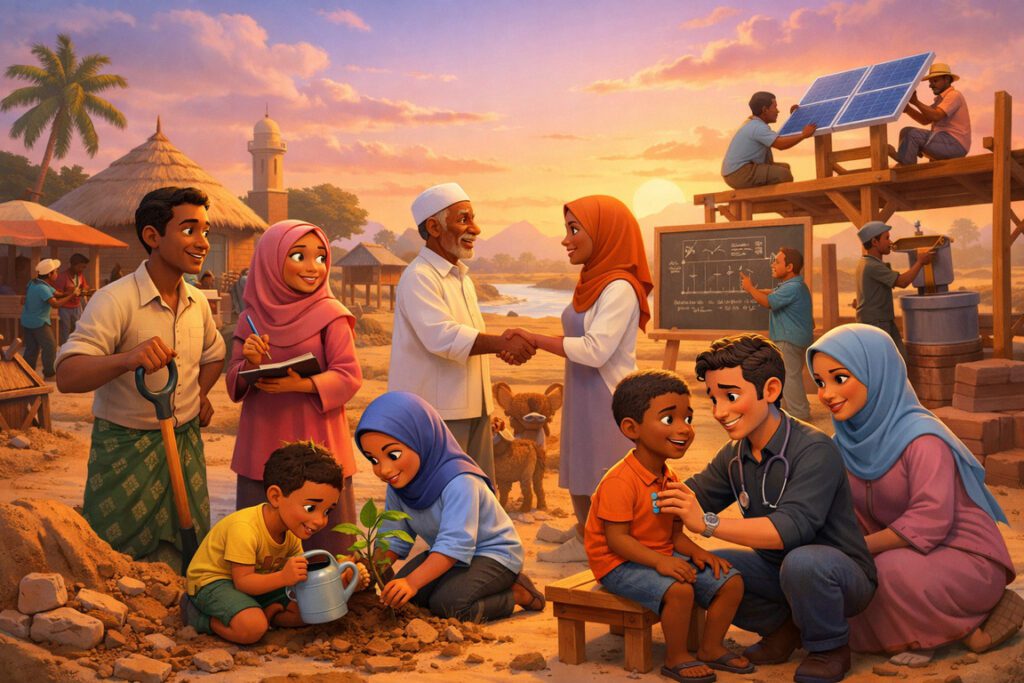
Take a journey to Kismayo Calenley, and you’ll witness something quietly extraordinary. Here, mothers’ voices shape water committees, youth plan digital skills classes, and elders debate how best to rebuild market stalls after a storm. Forget images of outsiders handing out blueprints and marching through villages with clipboards. The real story behind lasting change in Somalia is a movement where community members write their own future, fueled by deep pride, sharp insight, and relentless determination. The Al-Amin Somalian Foundation (ASFAFRICA) stands as both partner and catalyst, but never puppeteer. When communities design their own development, hope isn’t just planted—it grows roots and flourishes for generations.
Around the world, big institutions have poured billions into poverty reduction, health, and education, yet often see projects fade as soon as the funding dries up or the experts pack up. Why? Solutions designed from afar rarely fit the rhythms and realities of local life. Real progress springs from inside—the ideas, traditions, and aspirations of people who live and breathe every challenge and possibility. When locals own the process, every win feels personal. Donors and volunteers craving real, lasting impact will find the most powerful investments are those that help communities take the wheel.
The sections ahead reveal how putting local people at the center changes everything. Each story, case study, and insight showcases why the future of development is being designed, step by step, in the streets and meeting halls of communities themselves.
Local Genius at Work: Why Outsider Plans Often Miss the Mark
Every community is a world of hidden wisdom. Solutions that work in one village flop in another. In Somalia, imported water systems sometimes sit idle because no one’s trained to repair them, while a hand-dug well, planned by locals, keeps running through every drought. Harvard Business Review and The Economist both spotlighted projects that thrived only when adapted by residents, not visitors.
Trust in local knowledge isn’t just a feel-good idea—it’s a practical, measurable advantage. The World Bank finds community-led projects show 30% higher long-term success rates compared to top-down initiatives. In Kismayo Calenley, farmers rebuilt flood barriers using old methods combined with affordable new tech, outsmarting nature in a way no outsider blueprint could match.
Donors sometimes hesitate, worrying local leaders lack expertise or big-picture thinking. Data says otherwise. When villagers debate, design, and decide, ownership skyrockets. Broken pumps get fixed faster, new schools fill up with students, and everyone chips in to protect progress. The same dynamic is echoed in case studies from South Asia to East Africa: meaningful participation, not just consultation, delivers durable change.
Ask anyone who’s lived through a “consultant-driven” project that faded away. The lesson is clear: real genius lives in the community, waiting to be unleashed.
Trust, Pride, and Ownership: The Secret Ingredients of Enduring Progress
Lasting development isn’t just about bricks and budgets—it’s about people believing they control their destiny. When projects start with local priorities, trust replaces skepticism. Community meetings feel less like lectures and more like family gatherings. Success tastes sweeter because it’s earned, not gifted.
Kismayo Calenley offers proof. Years ago, health campaigns struggled when outsiders set the agenda. Today, locals shape every message and choose the most trusted messengers—midwives, faith leaders, and respected elders. Vaccination rates have soared, and rumor-fueled resistance has melted away.
A sense of pride builds momentum. As villagers see their efforts bloom—whether it’s thriving kitchen gardens or bustling sewing co-ops—they double down. Children brag about their parents’ roles in new initiatives. Even failures become learning moments, not reasons to give up. Ownership isn’t just the path to progress; it’s the anchor that holds it steady through storms.
Social scientists at MIT found that in dozens of countries, projects designed and run by locals survived wars, famines, and economic shocks better than externally managed programs. The power of pride and agency is, quite simply, unbreakable.
Case Studies in Courage: Real-Life Stories of Self-Designed Success
A single story can illuminate a thousand statistics. Meet Hodan, a mother in Kismayo Calenley whose dream was clean water for her children. She rallied her neighbors, convinced ASFAFRICA to supply basic materials, and together they built a rainwater catchment system that now serves hundreds. Not a single drop is wasted, and every family contributed labor, skills, or resources.
Young men frustrated by joblessness joined forces to open a small repair shop, turning discarded electronics into tools for local schools. With a small seed grant and training provided by ASFAFRICA, these entrepreneurs fixed not just gadgets but a problem: how to keep kids learning during frequent power outages.
A group of elders, concerned about rising child marriage rates, launched a youth mentorship network. Instead of waiting for laws or distant authorities, they brought parents, teachers, and teens into regular dialogue, slowly shifting attitudes. Now, more girls stay in school and finish their studies, with community ceremonies honoring their achievements.
Each project grew from lived experience and a clear sense of urgency. Donors and volunteers didn’t dictate the agenda—they responded, listened, and empowered local champions to lead the way.
Mixing Tradition with New Ideas: The Power of Hybrid Innovation
Old ways and new thinking don’t have to clash. In fact, the strongest solutions blend tradition with smart innovations. Kismayo Calenley’s farmers paired ancient soil conservation techniques with solar-powered pumps, boosting crop yields while saving money and water. This kind of hybrid approach would never come from an outsider’s desk.
Respected elders teach youth how to manage communal land, but also invite experts to train them in digital mapping. This collaboration preserves identity while unlocking opportunity. The result is a vibrant, adaptable approach that honors the past and welcomes the future.
Research by the Stanford Social Innovation Review underscores this pattern: communities that fuse indigenous knowledge with external resources outperform both “all-traditional” and “all-modern” approaches. These projects don’t just last—they inspire pride, creativity, and adaptability.
Donors who value tradition and innovation equally will find the richest impact grows where both are given space to shine. When communities are free to design, they create not just progress, but legacy.
Resilience in the Face of Crisis: Why Locally-Led Efforts Survive the Toughest Times
Disaster strikes with little warning, and centralized aid often arrives too late or misses the mark. Community-designed responses, by contrast, mobilize instantly. In Kismayo Calenley, neighborhood response teams organize food sharing, shelter repairs, and health checks within hours—not days—after a flood or fire.
During the COVID-19 pandemic, residents set up their own information hubs, translating global guidance into local languages and customs. Infection rates stayed lower than neighboring regions, proving that trust and agility save lives.
Long-term resilience is built by those closest to the ground. Local savings groups pool resources for emergencies. Youth monitor early warning systems for drought. Women’s cooperatives pivot quickly to distribute soap and masks. Each action is informed by real need, not theory.
Researchers from the International Institute for Environment and Development found that communities designing their own risk strategies recover faster and lose less—of both lives and livelihoods—than those relying on outside rescue. Donors eager to build enduring impact should look first to grassroots leaders in times of crisis.
How Community Design Accelerates Inclusion and Justice
Projects led by locals naturally put marginalized voices front and center. Elders, women, youth, and people with disabilities each bring unique perspectives, making solutions more equitable and far-reaching. Meetings feel safer, participation rises, and hidden issues come to light.
In Kismayo Calenley, a community forum identified girls’ dropouts as a crisis. Rather than blaming families, the group created after-school programs, free sanitary supplies, and mentorship circles, all run by women volunteers. The dropout rate dropped by half in two years.
Minority clans, often sidelined in regional planning, now run their own advocacy groups, ensuring water access and fair representation. These wins ripple out—improving trust, social cohesion, and security for everyone.
Donors seeking to back justice and equality will find local design amplifies impact in ways even the best-intentioned outsiders cannot match. Lasting change comes when all voices matter.
Donors as Enablers: The Power of Flexible, Respectful Support
The best donors aren’t puppet-masters. They’re coaches, collaborators, and learners. By giving communities flexible grants and letting them set priorities, donors fuel the creative fire needed for real impact.
ASFAFRICA’s approach is a masterclass in partnership. Every project proposal comes from the grassroots, reviewed by community boards and local experts before funding is released. Results are tracked by both outsiders and insiders, making sure transparency and learning go hand in hand.
When donors share knowledge—finance, technology, communications—they unlock doors for communities to experiment, adapt, and thrive. Volunteering is equally valuable: sharing time, skills, and friendship creates bonds deeper than any budget.
Case studies across Africa confirm that flexible funding, trust, and open communication produce not just success, but deep loyalty and future collaboration. Donors looking for a legacy, not just a line item, will find their match in community-designed projects.
Learning From Setbacks: Why Local Projects Bounce Back Faster
Failure is a teacher, not a death sentence. When projects are homegrown, communities quickly spot problems and adjust course. External experts often miss early warning signs or stick to rigid plans, wasting time and money.
Kismayo Calenley’s market cooperative faced theft and infighting its first year. Rather than abandoning the venture, members gathered for honest feedback sessions, identified leadership gaps, and launched new accountability systems. Profits rebounded, and other groups copied their solution.
Documented by the Overseas Development Institute, such adaptive management outperforms even well-resourced international programs. Locals own both the problems and the fixes, building collective muscle for future challenges.
Donors and volunteers can play a crucial role here, encouraging transparency, patience, and a growth mindset. Instead of pulling the plug, they can ask, “What did we learn—and how do we build back stronger?”
Scaling Up and Spreading Out: How Local Models Inspire National Change
Community-designed success is contagious. When a village cracks the code—on water, health, education—neighbors and even government officials take notice. Learning exchanges, media coverage, and study tours help strong ideas leapfrog to new places, adapted for different realities.
Kismayo Calenley’s waste management system, invented by local youth, is now being piloted in four other Somali towns. ASFAFRICA helps coordinate visits, share manuals, and train new leaders, creating a ripple effect that’s as organic as it is powerful.
National ministries increasingly seek local partners for scaling innovations. Evidence from the World Bank and Gallup shows these partnerships are more likely to endure and remain accountable than those built from the top down.
Donors with vision can invest not just in single projects, but in the infrastructure for spreading local genius far and wide. That’s the real definition of legacy.
The Future Is Designed by the People—Join the Movement
As the sun sets over Kismayo Calenley, the stories shared here are more than inspiration—they’re a blueprint for every donor, volunteer, and policymaker craving real, lasting impact. When communities design their own development, progress is authentic, ownership runs deep, and solutions fit the complexity of real life.
Every success, setback, and adaptation proves a point: trusting local people is not a risk, but a reward. Donors and volunteers who choose this path join not just a project, but a revolution—one driven by pride, resilience, and the bold creativity of everyday citizens.
If you believe in people-powered progress, now is the time to act. Back a community, share your skills, and witness the magic that unfolds when hope, determination, and ownership come together. The next breakthrough is waiting—not in a distant boardroom, but right here, where communities draw their own map to a brighter tomorrow.
Hungry for more? The stories of self-designed success are still being written—and your chapter starts now.