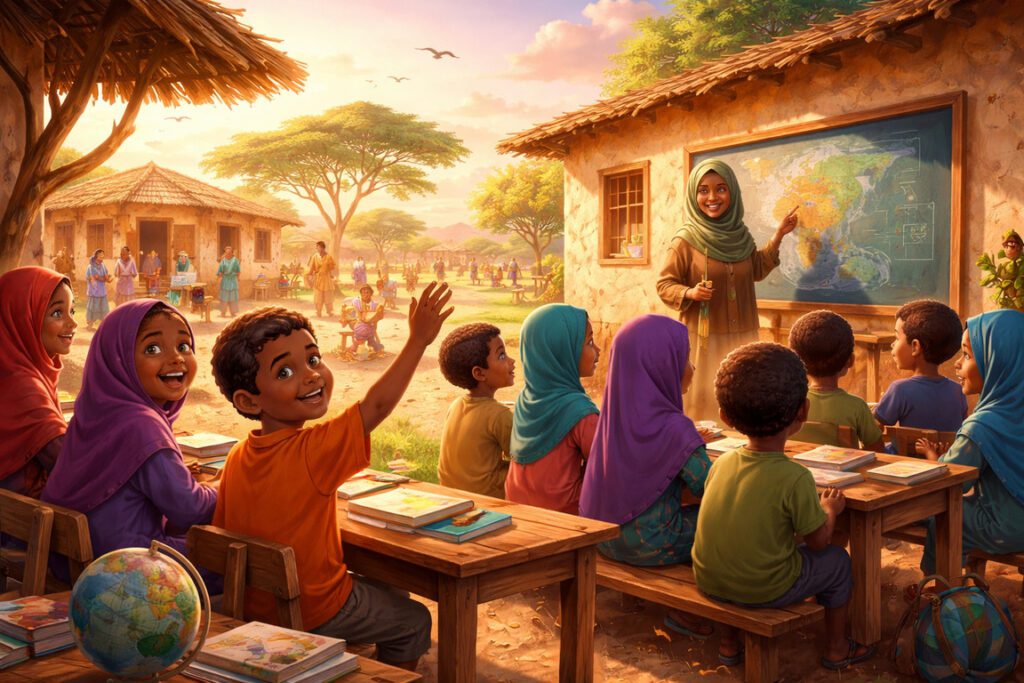
Change does not announce itself with trumpets. It creeps in quietly, disguised as paint drying on a crumbling wall or the soft shuffling of new shoes along a dusty corridor. In Kismayo Calenley, the revival of one neglected school means more than a renovated building; it signals a surge of optimism that rewrites destinies. Step inside the classrooms transformed by the Al-Amin Somalian Foundation, and you witness lives in mid-pivot—children’s eyes bright with possibility, teachers recharged with hope, parents finally daring to believe in something better.
Years of conflict, displacement, and scarcity left a generation on the verge of forgetting what normalcy should feel like. School was once a word loaded with impossibility for so many families. Now, when a bell rings at dawn, children leap from bed, grab faded backpacks, and dash toward lessons. What changed? Not just bricks and mortar—mindsets, expectations, and futures shifted. Classrooms reborn under ASFAFRICA’s stewardship have become safe havens for dreams.
Each school tells its own story of resurrection. A once-abandoned block, overrun by weeds, now hums with life, laughter, and learning. Parents gather at pickup, trading tales of how their children’s confidence soars. Volunteers and donors do not just visit; they join a living legacy of transformation. What began as charity turns into community, one classroom at a time.
Real stories drive real progress. Meet Ayaan, who, after stepping through the doors of her restored school, discovered a passion for science that outshined her fears. Or Farhan, whose stutter faded as he found his voice in the school’s new debate club. These journeys start in a single classroom but ripple outward, shaping families, neighborhoods, and, in time, a nation ready to rebuild itself.
From Broken Desks to Building Character: The Physical Revival
The smallest details reveal the biggest transformations. A cracked chalkboard replaced by a bright whiteboard does more than improve legibility—it signals to students that they matter. When volunteers from Al-Amin Somalian Foundation help patch leaky roofs or replace battered desks, dignity is restored to the entire learning experience. Repairs are not cosmetic. They are statements of belief in every child who sits at a desk or raises a hand.
Local artisans, hired for restoration projects, take pride in their handiwork. Their craftsmanship echoes in every corner, infusing the building with community spirit. Small fixes lead to major changes. When rain no longer disrupts lessons, attendance climbs. When toilets are safe and clean, girls stop missing school each month. Incremental improvements compound into permanent progress.
Even play spaces get a second life. Fenced-in fields and painted games on concrete transform recess from a chaotic scramble into organized play. Children race and laugh, their minds free to dream as their bodies grow strong. Sports teams form. Inter-school competitions emerge, binding communities with newfound pride and healthy rivalry.
Restoration builds more than facilities—it fosters responsibility. Students volunteer to plant gardens, keep halls tidy, and decorate with murals. This shared ownership teaches stewardship and respect, values that carry forward long after the paint has dried. As one teacher said, “We’re not just fixing schools; we’re raising leaders.”
Teachers Unleashed: The Real Engines of Change
In every thriving classroom stands a teacher whose spark lights the way. School rebuilding does not stop at bricks—it invests deeply in people. Al-Amin Somalian Foundation prioritizes teacher training, knowing that inspired educators change lives faster than any curriculum. Through hands-on workshops and peer mentoring, teachers gain new skills, confidence, and professional camaraderie.
Teachers trade isolation for collaboration. New pedagogies break monotony; classes become interactive, lessons lively. Children’s hands shoot up, questions flow, and learning feels alive. Empowered educators use storytelling, roleplay, and group work to animate even the dullest subjects. Results are measurable: test scores rise, drop-out rates fall, and word spreads that something remarkable is happening inside these classrooms.
Recognition fuels further success. Teachers who once felt overlooked are celebrated, their achievements amplified at community meetings. Their stories attract new talent, reversing the brain drain that once plagued the region. One standout example: a veteran math teacher in Kismayo who pioneered student-led tutorials, doubling pass rates in one year.
Human investment breeds human growth. Alumni return to offer career talks, forming a virtuous cycle of inspiration. These teachers are not just delivering knowledge; they are modeling resilience, empathy, and ambition. Their influence travels well beyond the classroom, shaping a new generation ready to teach, build, and lead.
Learning Without Limits: A Classroom for Every Child
True progress measures itself by inclusion. Before school rehabilitation, hundreds of children in Kismayo Calenley were left out—girls pressured to stay home, disabled students hidden from view, children from nomadic families constantly on the move. The new wave of classroom revival redefines who belongs, erasing the old lines of exclusion.
Girls’ education receives special focus. Female mentors encourage girls to take up leadership roles in clubs and student government. Clean, private restrooms and targeted scholarships help keep girls in school, while local awareness campaigns challenge outdated stereotypes about gender roles. Results speak loudly: every year, more girls outpace their peers in exams and extracurricular activities.
Disabled children, once overlooked, are now fully welcomed. Classrooms add ramps, tactile learning aids, and flexible seating arrangements. Teachers receive specialized training to adapt lessons for all abilities. Amina, a deaf student, became a celebrated poet after her school introduced sign language classes—a testament to the power of inclusive education.
No child is forgotten. Mobile classrooms and flexible schedules allow children from nomadic or displaced families to keep up academically. Partnerships with local leaders ensure attendance remains high even during migration seasons. Inclusion becomes the norm, not the exception. Every student counts, every dream matters.
From Hunger to Hope: Tackling the Barriers to Learning
Empty stomachs are poor companions to education. For countless Somali children, hunger used to outmuscle curiosity, dragging attention away from lessons. With the help of ASFAFRICA and its partners, school kitchens now serve nutritious meals—simple but sustaining—removing one of the biggest obstacles to learning.
School feeding programs become magnets for enrollment. Parents who once hesitated to send children now know they return home healthier, stronger, and more engaged. Teachers report that breakfast transforms sluggish mornings into energetic discussions. Students once plagued by fatigue now finish assignments and join after-class activities.
Malnutrition shrinks; academic performance grows. Regular meals improve concentration and memory, two ingredients for success often overlooked by policymakers. Community members contribute fresh produce, creating a cycle of giving and receiving that deepens bonds between schools and families.
Case studies abound: a rural school in Calenley doubled its attendance within months of launching a lunch initiative. A single mother credits the daily meal for keeping her three sons in class instead of laboring in the market. Meals are not charity; they are investments in capacity, character, and long-term prosperity.
Lighting the Path: Technology’s Quiet Revolution in Classrooms
Education is evolving, and Somali schools refuse to be left behind. What once seemed futuristic—a computer lab in a rural school—is now reality, thanks to thoughtful donor support. Laptops, projectors, and internet access connect Kismayo students to global knowledge, raising aspirations and digital skills in equal measure.
Technology democratizes learning. No longer does a child’s future hinge on geography or income. Online resources supplement lessons, giving students opportunities to explore languages, science, and mathematics far beyond the standard syllabus. Digital literacy becomes a bridge to scholarships, remote mentorships, and job opportunities.
Teachers, too, reap the benefits. Digital tools simplify lesson planning, record keeping, and communication with parents. Workshops in technology empower teachers to introduce coding, design, and research projects that spark curiosity and build marketable skills. One group of high school girls recently launched a local blog on nutrition, inspired by their digital storytelling unit.
The tech revolution fosters innovation. Science fairs feature robots made from recycled parts. Coding clubs compete nationally, raising the profile of Kismayo Calenley as a hub of talent and ingenuity. A generation once locked out of the digital world is now equipped to shape it, armed with tools and confidence to solve tomorrow’s problems.
The Pulse of Progress: Measuring Real-World Impact
Data is the story behind the story. Every decision by Al-Amin Somalian Foundation is grounded in careful measurement—attendance logs, test scores, graduation rates, health outcomes. Progress is tracked, celebrated, and, when necessary, recalibrated. This relentless focus on evidence ensures that every donor dollar and volunteer hour is put to its best use.
Quantitative and qualitative results fuel momentum. Numbers reveal trends, but personal stories provide texture. Parents speak of children who read at night under solar lamps, hungry for more knowledge. Principals point to graduation ceremonies that have grown from a handful to packed auditoriums.
Transparency builds trust. Regular impact reports, shared with donors and community leaders, highlight achievements and acknowledge setbacks. This honesty invites continuous improvement and deeper collaboration. Volunteers see their efforts reflected in the upward curve of success stories; donors see their investment multiply with each school year.
Continuous assessment drives excellence. Programs that underperform are reimagined. New partnerships are forged based on proven needs. The foundation’s reputation for accountability attracts fresh support, cementing its place as a catalyst for meaningful, measurable change.
Stories of Change: From Despair to Triumph
Numbers impress, but human stories move hearts. Consider the journey of Bashir, a boy who entered a rebuilt classroom unable to read, withdrawn and shy. Today, he tops his class and leads the school debate team, crediting the patient encouragement of his teachers and the new library that became his second home.
Or listen to Hani, a young woman who credits her secondary school’s adoption with giving her the courage to study medicine. She returns each year to mentor girls who remind her of her younger self—timid, uncertain, but brimming with untapped potential. Such narratives are multiplied in every corner of the district.
Transformation does not occur in isolation. Parents, once suspicious of outside intervention, now lobby for more schools to join the program. They share stories of daughters who teach their mothers to read, of sons who volunteer to tutor siblings. This is not a top-down miracle; it is a grassroots movement fueled by hope, tenacity, and shared dreams.
Partnership is the thread running through each account. Donors, volunteers, and community members join in common cause, each contributing something vital—time, knowledge, resources. Every hand helps lift a child, a family, a community from limitation to possibility.
Volunteering: The Unseen Hand Behind Every Success
Behind every success story stands a network of volunteers whose dedication brings projects to life. Some travel across continents, others arrive on foot from nearby villages. Each one leaves a mark. From painting classrooms to coaching sports, organizing book drives to leading computer workshops, their impact is felt in every smile, every word of encouragement.
Volunteers gain as much as they give. Immersion in local culture, deep relationships with students, and the satisfaction of tangible progress create lifelong bonds. Many return home transformed—ambassadors for Somalia’s promise, not its pain. Their stories attract new supporters, expanding the movement’s reach.
Case studies illuminate the ripple effect. A British volunteer launched a pen-pal program connecting Somali students with peers in the UK. Another organized a science camp that sparked an ongoing robotics club. These initiatives add layers of experience and learning, enriching the educational tapestry of Kismayo Calenley.
Recognition of volunteers fosters a culture of gratitude and growth. Awards, shared meals, and heartfelt farewells remind everyone that progress is a team effort. Every volunteer, no matter how brief their stay, becomes part of the legacy. Their stories inspire the next generation to believe that anything is possible with unity and purpose.
Reimagining the Future: Conclusion and the Next Chapter
Walking out of a revitalized school in Kismayo Calenley, you carry more than memories—you carry proof that hope is not a luxury, but a necessity. The journey from decay to dynamism, from empty classrooms to overflowing possibilities, is a testament to what collective action can achieve. Al-Amin Somalian Foundation has shown that rebuilding futures is less about cement and more about courage, vision, and partnership.
The work is not done. For every school transformed, many more await their chance. The foundation’s blueprint—measured impact, local leadership, innovative programs—offers a model worth scaling. Donors and volunteers are not just supporters; they are architects of hope, builders of lasting legacies.
This story does not end with a period, but with an open invitation. Join the movement that turns despair into opportunity. Be the spark in a young mind, the cheer in a classroom, the reason a child believes in tomorrow. Rebuilding futures is a team effort—one classroom, one volunteer, one donor at a time.
Tomorrow’s leaders are being shaped behind those repaired doors. Their futures depend not on chance, but on the choices we make today. Stand with us, step inside, and see what happens when hope is rebuilt—one classroom at a time.